| Blind Components |
| AB Cloth Tape |
Size designation of Venetian blind cloth tape for 2” wide slats with 1 11/16” spacing between slats. |
 |
| Bead Chain |
Made up of small balls one after another fused to string or joined by pieces of metal. Can be metal or plastic beads. Can be continuous or have a connector securing two ends together. |
 |
| Blind |
Any window covering with tiltable and moveable slats for controlling light and privacy. |
 |
| Bottom Rail |
The bottom-most horizontal piece on blinds and shades. |
 |
| Bottom Up Shade |
A shade that only rises from the bottom and goes up. |
 |
| Box Bracket |
Box-shaped mounting brackets that are fastened to the window frame or wall and are used to attach and install the headrail of a horizontal blind. |
 |
| Brackets |
Installation parts that are fastened to the window frame or wall and used to attach and install the headrail on a window treatment. |
 |
| Carrier |
This internal vertical blind part carries the vanes back and forth across the headrail. It is a geared device that also controls the angle of the vanes. |
 |
| Carrier Clip |
This clip protrudes from the carrier and holds the vanes of a vertical blind to the carrier. Also may be called a “stem” or “vane clip.” |
 |
| Center Stack |
When vertical blinds are drawn open and the vanes stack in the middle of the head rail. |
 |
| Center Support |
Metal bracket installed usually between box brackets on a wide horizontal blind to provide more mounting support. |
 |
| Chain & Clip |
Plastic or metal bead chain that connects to the weights on the bottom of a vertical slat via plastic clips. Chain & Clip allows for even spacing of slats when the blind is in operation. |
 |
| Cloth Tape |
Supports and controls the slats on a horizontal blind. Made of two parallel strips of cloth connected at right angles to each other by cloth or string support pieces. These support pieces support the slats and control the tilt of the slats. The size of cloth tape that Fix My Blinds stocks are:
- 2” Cloth Tape – AB: For horizontal blinds with 2” wide slats and 1 11/16” spacing between slats.
- 2” Cloth Tape – Designer: For horizontal blinds with 2” wide slats and 1 ¾” spacing between slats.
- 2 3/8” Cloth Tape – DE: For horizontal blinds with 2 3/8” wide slats and 2” spacing between slats.
- 1 3/4” Cloth Tape – X: For horizontal blinds with 1 3/4” wide slats and 1 1/2” spacing between slats.
|
 |
| Clutch |
A tensioned mechanical device that assists the raising and lowering of a blind or shade. Operates with a continuous loop of cord or plastic/metal bead chain. |
 |
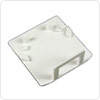
| Clutch Cover |
Plastic piece that covers the operational end of the clutch mechanism on a clutch-operated blind or shade. |
 |
| Condenser |
Consolidates smaller strings into a plastic or metal assembly to which a larger pull cord is attached. |
 |
| Continuous Cord Loop |
A length of braided cord fused together by heat and with adhesive to create an endless loop. |
 |
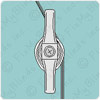
| Cord Cleats |
A metal or plastic piece mounted to the wall to wrap long cords around. |
 |
| Cord Guide |
A grommet-like part that directs the string so that it travels in to prevent wear. |
 |
| Cord Joiner |
See “Condenser.” |
 |
| Cord Lock |
A mechanism used to lock a blind or shade to the desired height when raising and lowering. Holds the lift cords by pressure or friction. |
 |
| Cord Loop System |
A blind or shade that operates with a clutch and continuous cord or bead chain loop to raise and lower it. |
|
| Cord Stop Assembly |
“See Condenser.” |
 |
| Cord Tilt |
Corded mechanism used in some horizontal blinds to tilt the slats instead of a tilt wand mechanism. |
 |
| Cradle |
Plastic or metal device that holds the drum in place and guides the ladder and lift cord as they enter the bottom of the head rail of horizontal blinds. Sometimes called a 'saddle'. |
 |
| DE Cloth Tape |
Size designation of Venetian blind cloth tape for 2 3/8” wide slats and 2” spacing between slats. |
 |
| Designer Cloth Tape |
Size designation of venetian blind cloth tape for 2” wide slats and 1 3/4” spacing between slats. |
 |
| Drum |
A barrel-shaped plastic or metal piece that is seated in the cradle in the head rail of a horizontal blind. The string ladder or cloth tape connects to and hangs from the drum. |
 |
| End Cap |
End caps are used to cover the non-functioning ends of the bottom and top rails of blinds and shades. |
 |
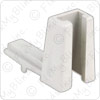
| Equalizers |
Gathers two or more cords together to create a stop device that prevents a shade from going down further than needed. Also helps keep the cords even. |
 |
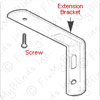
| Extension Brackets |
Projects a blind or shade away from any obstructions that may interfere with proper operation. |
 |
| Head Rail |
The head rail is the top-most part of a blind or shade that contains the working mechanism(s) that operate it. |
 |
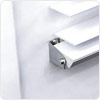
| Hold Down Brackets |
Used to hold a blind or shade’s bottom rail in place. Common with blinds mounted on doors. |
 |
| Horizontal |
Parallel to level ground. |
 |
| Inside Mount |
When a blind or shade is installed inside a window frame. |
 |
| Lift Cords |
The braided nylon, polyester or cotton cord that is used to raise and lower a blind or shade. Common sizes range from 0.9mm to 4.0mm in diameter. |
 |
| Lift Tape |
Ribbon-like flat material used as lift cord on certain types of blinds and shades. About 2.5mm wide and as thin as a piece of construction paper. |
 |
| Louvers |
The horizontal wooden panels that make up plantation shutters. Can be 1” to 4 ½” wide. |
 |
| One Way Draw |
When vertical blinds are drawn open and all of the vanes stack on the same side of the head rail as the controls. |
 |
| Outside Mount |
When a blind or shade is installed outside of a window frame. |
 |
| Plastic Washers |
Small, round plastic pieces used to secure knots from slipping through holes. |
 |
| Pleat Size |
Refers to the height of each pleat from fold to peak. Some common pleat sizes are 3/8”, 3/4", and 1 1/4". |
 |
| Projection |
The distance between the wall to the rear edge of the blind. Sufficient clearance must be achieved for some blinds and shades to operate properly. |
 |
| Pull Cords |
Heavier cord that attaches to the lift cords with a condenser on some types of blinds and shades. |
 |
| Restring Needle |
A metal needle used to thread new string through the fabric of pleated and cellular shades. |
 |
| Reverse Stack |
When vertical blinds are drawn open and all of the vanes stack on the side of the head rail opposite the controls. |
 |
| Route Hole |
The hole drilled or punched into the slats of horizontal blinds that the lift cords run through. |
 |
| Shade |
Any window covering made of a continuous material, and does not contain slats. Normally just raises up and down. |
 |
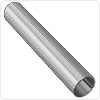
| Shade Roller |
Long aluminum tube or wooden dowel with a winding mechanism on which shade fabric is wrapped. |
 |
| Slats |
The metal, wood or vinyl strips that make up a horizontal blind. |
 |
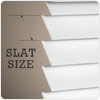
| Slat Size |
Measurement of the depth of a slat from front to back. |
 |
| Spacer Blocks |
Plastic pieces that fit between the wall and the bracket used to clear trim and other obstacles while mounting a blind or shade. |
 |
| Split Stack |
When vertical blinds are drawn open and the vanes stack evenly on the left and right sides of the head rail. |
 |
| Standard Operation |
The most common placement of control positions for blinds and shades. For both blinds or shades, lift operation is on the right. For blinds, tilt operation is on the left. |
 |
| Vertical Blind Standard Operation |
A “One Way Draw” is standard. All of the vane stack on the side of the head rail with the controls when the blind is opened. |
 |
| Cellular / Pleated Shade Standard Operation |
Operates from the bottom up only and has a cord lock with strings coming down from it. Pull on the strings to raise the blind up and then pull the strings to the left or right to lock in place. |
 |
| Horizontal Blind Standard Operation |
Pulls up from the bottom with strings coming down from the top. Pull the string to the left or right to lock the blind. Uses a tilt wand. Twist the wand to control the tilting of the slats. |
|
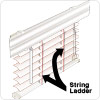
| String Ladder |
Supports and controls the tilting of the slats on a horizontal blind. Made of two parallel pieces of string connected at right angles to each other by string called rungs. |
 |
| Swivel Bracket |
Mounting brackets for inside mount shades only. They are especially useful for shallow depth windows. Most only require about ½” mounting depth. |
 |
| T-Handles |
Metal handles used in the place of older and larger window cranks that can interfere with the correct operation of a blind or shade. |
 |
| Tassels |
Decorative wood, plastic or brass pieces attached the end of lift and pull cords. |
 |
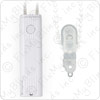
| Tensioner |
Plastic part that keeps tension on loops of cord or bead chain. |
 |
| Tilt Mechanism |
Mechanism used in some horizontal blinds to tilt the slats. Also referred to as a “tilter.” |
 |
| Tilt Rod |
Metal rod that is situated inside the headrail of horizontal blinds. Not to be confused with a Tilt Wand. |
 |
| Tilt Wand |
See “Wand.” |
 |
| Top Down Shade |
A shade that only lowers from the top and goes down. |
 |
| Top Down / Bottom Up Shade |
A shade that raises and lowers from the top and the bottom. Has a floating middle rail. |
 |
| Two On One Headrail |
Two blinds, or shades sharing the same head rail. |
 |
| Valance |
A decorative piece that covers the headrail of a blind, or shade. |
 |
| Valance Clip |
Device that connects the valance to the headrail on a blind. |
 |
| Vanes |
The vinyl, fabric or wood panels hanging from a vertical blind headrail. |
 |
| Vane Savers |
Metal clips used to repair broken holes at the top of vinyl or PVC vertical blind vanes. Use curved for all curved vanes, even those with an S-curve. Use flat for vanes that are completely flat. |
 |
| Vertical |
Up and down. |
 |
| Wand |
Wooden, plastic, fiberglass or metal rod used to open and close the slats or vanes of a blind. |
 |
| Wire Restring Tool |
An 18” length of galvanized steel wire used to thread new string through various types of blinds. Especially useful with long blinds and shades. |
 |
| X Cloth Tape |
Size designation of venetian blind cloth tape for 1 3/4” wide slats and 1 ½” spacing between slats. |
 |


 Back to the top


